

Disclosure: This article may contain affiliate links, which means we may earn a commission if you purchase through these links — at no extra cost to you. We are a member of the Amazon Services LLC Associates Program and we earn from qualifying purchases. See our Disclosure Policy for more information.
🕊️ Simple Summary
If someone you care about is grieving, don’t worry about saying everything perfectly. Be present, listen without trying to fix their pain, offer practical support, and remember that grief doesn’t end after the funeral. Small acts of kindness and consistent check-ins often mean more than you’ll ever know.
NOTE:
This guide is for general educational purposes only and is not legal or medical advice. Laws and healthcare requirements vary by state, so speak with an attorney or healthcare professional if you need help completing your documents or making decisions about your medical care.
At some point, nearly all of us will know someone who is grieving. They may be mourning the loss of a spouse, parent, child, friend, or even a beloved pet.
Like most people, we want to help. We want to say the right thing and bring comfort. Instead, many of us keep our distance because we’re afraid of saying the wrong thing.
Here’s what I want you to remember: you don’t need the perfect words. What the grieving person needs is to know they are supported.
In the sections that follow, you’ll learn how to support someone who is grieving, from what to say and what not to say to the small acts of kindness that often make the biggest difference. Most importantly, I hope you’ll discover that you don’t need perfect words. You simply need to be willing to show up.
Grief hasbeen part of my life for as long as I can remember.
I’ve experienced grief as a son, a grandson, a friend, a pet owner, and as a funeral professional helping families through some of the most difficult days of their lives.
I lost my father when I was 13 years old. A few years later, I lost my grandmother, someone I was incredibly close to. At 27, my best friend, Darci, passed away unexpectedly. Not long after, I said goodbye to my dog, Dillenger.
Each loss was different.
Each one taught me something about grief, healing, and the importance of having people who simply show up.
That’s why I want to help you support someone who is grieving, especially when words don’t seem like enough.
Understanding What Someone Who Is Grieving May Be Experiencing
Before you can support someone who is grieving, it helps to understand one simple truth:
Grief is messy and deeply personal.
Some people cry openly. Others become quiet or withdrawn. Some feel angry, while others seem numb. A grieving person may experience all of these emotions, and many others, in the same day.
There is no set pattern, no timeline, and no single “right” way to grieve.

Everyone Grieves Differently
In the late 1960s, psychiatrist Elisabeth Kübler-Ross introduced what became known as the Five Stages of Grief: denial, anger, bargaining, depression, and acceptance.
While these stages have helped many people understand grief, it’s important to remember that they are not a checklist. People don’t always experience every stage, and they rarely experience them in order.
If you’d like to learn more about the grieving process, I encourage you to read our guide, Grief 101: Understanding the Grieving Process.
The most important thing to remember is this: grief rarely follows a predictable path.
There Is No “Right” Way to Grieve
Every loss is different because every relationship is different.
One person may find comfort in baking pies or looking through old photographs. Another may go for long walks, spend time alone, or express anger through writing or art.
Different responses deserve understanding, while coping choices should protect the person and others from harm.
When you understand that grief is deeply personal, it becomes easier to support someone without judging how they choose to cope.
Why Your Presence Matters More Than Perfect Words
We can’t take away someone’s pain, but we can walk beside them through it.
Grief makes everyone uncomfortable. Friends and family often return to their normal routines while the grieving person is left to face the silence, the empty chair at the table, and the memories that suddenly appear without warning.
They may not know what they need.
They may not feel like talking.
They may not seem like themselves.
That’s okay.
For many people, simply knowing someone is nearby is enough to make an unbearable day a little easier.
When my friend Darci died, my mom didn’t ask what I needed. She knew I probably didn’t know myself.
She changed her schedule, got on a plane, and showed up at my door. Before she even arrived, she had groceries delivered so I wouldn’t have to think about shopping or cooking.
She couldn’t take away my grief.
But she made sure I didn’t have to carry it alone.
That’s the kind of support people remember long after the funeral is over.

Supporting Someone During the First Few Days
The first few days after a loss are often the most chaotic. Emotions can swing from sadness to anger to confusion in a matter of minutes. At the same time, the grieving person may be making important decisions about funeral arrangements, finances, and family responsibilities.
That’s why this is the time to be gentle, stay close, and help without waiting to be asked.

Reach Out, Even If You Don’t Know What to Say
Phone calls, emails, and even a short text can be enough to let a grieving person know that you are there for them. Don’t worry about finding the perfect words.
Simply reaching out lets someone know they aren’t alone.
Offer Specific Help Instead of General Offers
Instead of saying, “Let me know if you need anything,” be specific about how you’d like to help.
Look around for practical needs. Maybe the lawn needs mowing, the dog needs walking, groceries need to be picked up, or a meal would make the day a little easier. Even showing up with a cappuccino and a couple of blueberry muffins can remind someone they’re being cared for.
Here are a few examples:
- “I’m going to stop by after work this week to walk your dog. Would 6:00 be okay?”
- “I’d like to take the kids to the playground Saturday morning. Does 10:00 work for you?”
- “I’m headed to the grocery store. What can I pick up for you?”
- “I’m going to mow your lawn this weekend so you don’t have to worry about it.”
- “I made dinner tonight and would love to drop it off around 6:00 if that’s okay.”
Specific offers remove the burden of making decisions and make it much easier for someone to accept the help they need.

Attend Services If Appropriate
Funeral services, family visitation, and memorial services can be overwhelming for the grieving. There are people coming in all directions, some known and some not well known.
Showing up in person tells the grieving family something words often can’t: I’m here, and you don’t have to face this alone.
Respect Their Wishes
It’s hard to know what someone wants during a time of grief. The grieving can’t always communicate what they want or how.
When the grieving are adamant about their wishes, it is important that we respect them. If they don’t want visitors, limit the number. Likewise, if they want to be alone, let them. Their emotional state is all over the place, especially in the early days.
What they want today may change tomorrow.
It’s also important not to take it personally if they pull away for a while.
Grieving people often need time alone to process what has happened. If they stop returning your calls or tell you they want some space, respect their wishes, but don’t disappear.
A simple text every week or two saying, “I’m thinking about you,” lets them know you’re still there whenever they’re ready.
What to Say to Someone Who Is Grieving
Many of us want to say more than “I’m sorry,” but worry about saying the wrong thing. If you’ve ever felt that way, you’re not alone.
The truth is, grieving people usually aren’t looking for perfect words. They’re looking for someone who will acknowledge their loss, offer comfort, and remind them they don’t have to face this difficult time alone.
Throughout my time working with grieving families, I’ve seen how even the smallest acts of kindness can make a lasting difference. I learned that the people they remembered most weren’t the ones who had the perfect words. They were the ones who showed up, sat quietly beside them, offered a hug, shared a memory, or simply let them know they cared.
Your presence and sincerity matter far more than saying everything perfectly.

Simple, Compassionate Things You Can Say
The most meaningful words are genuine. Speak from the heart, and don’t worry about sounding rehearsed.
- “I’m so sorry for your loss.”
- “I’m thinking about you and your family.”
- “I don’t have the right words, but I’m here for you.”
- “I can’t imagine how difficult this must be.”
- “I love you, and I’m here whenever you need me.”
- “Tell me about them if you’d like. I’d love to hear your favorite memories.
- “I’m here to listen whenever you’re ready.”
If you’re not sure what to say, these simple phrases can mean more than you realize.
When It’s Okay to Simply Listen
Sometimes words don’t need to be exchanged. A grieving person may simply need a safe place to cry, vent, or sort through their thoughts.
Not every statement needs a response, and not every question is really a question. Sometimes the greatest gift you can give is your presence and your willingness to listen without trying to fix the pain.
A simple hug, a hand on their shoulder, or quietly sitting beside them can say more than words ever could.
Don’t Be Afraid to Mention Their Loved One’s Name
Many people worry that bringing up the person who died will make someone more upset. In reality, many grieving people are afraid their loved one will be forgotten.
In the days, months, and even years to come, it’s okay to mention their loved one by name. Share a favorite memory, tell a story that makes you smile, or simply say, “I was thinking about John today.”
Keeping someone’s memory alive isn’t living in denial—it’s honoring the important role they played in the lives of those who loved them.
What Not to Say
When someone is grieving, it’s natural to want to ease their pain. Unfortunately, some of the most common phrases people use can unintentionally minimize what the grieving person is feeling.
Remember, your goal isn’t to explain their loss or make them feel better. Your goal is simply to let them know they aren’t facing it alone.
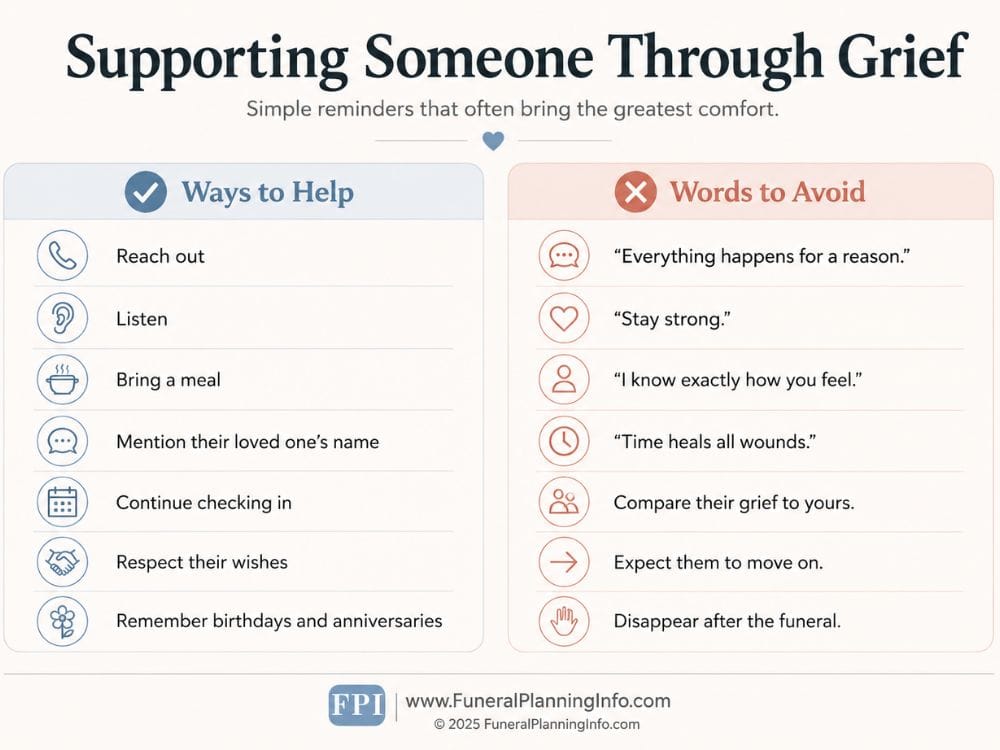
Common Phrases That Can Hurt
- “Everything happens for a reason.”
While intended to provide comfort, this can make someone feel like their loss was somehow meant to happen. In the early days of grief, they may not be ready to hear that. - “I know exactly how you feel.”
Even if you’ve experienced a similar loss, every relationship and every grief journey is different. Instead of creating a connection, this statement may make someone feel their unique experience is being compared to yours. - “They’re in a better place.”
For those with strong faith, this may eventually bring comfort. But immediately after a loss, many people simply wish their loved one were still with them. - “Stay strong.”
This can unintentionally send the message that they shouldn’t cry or show emotion. Grieving people need permission to experience their feelings, not hide them. - “Time heals all wounds.”
Time may soften grief, but it doesn’t erase it. Many people continue to miss their loved one for years, and that’s perfectly normal.
Most people say these things because they care, not because they want to cause pain. However, these well-meaning comments can leave a grieving person feeling misunderstood.
Better Alternatives
Instead of trying to find the perfect words, focus on being genuine. Simple expressions of care are often the most meaningful.
What to say instead
Instead, offer words that acknowledge their pain and remind them they don’t have to face it alone.
- “I’m so sorry you’re going through this.”
- “I can’t imagine exactly what you’re feeling, but I’m here for you.”
- “Your loved one meant so much to so many people.”
- “It’s okay to cry. You don’t have to be strong around me.”
- “Take all the time you need. Grief doesn’t have a schedule.”
You don’t have to be a grief counselor or have the perfect response. Sometimes the most comforting words are simply:
“I’m here for you.”
Then be there.

Practical Ways to Help Beyond the Funeral
One of the hardest parts of grief often begins after everyone else has gone home. One thing I’ve noticed while helping families is that the support often fades just as the reality of the loss begins to settle in. That’s when a simple phone call or visit can mean the most.
While life begins to move on for everyone else, the grieving person is still learning how to live without someone they love.
That’s when your support matters.

Continue Checking In
Many people hesitate to reach out because they worry they’ll remind someone of their loss. The truth is, they haven’t forgotten.
A simple text every week or two can remind them they aren’t facing this alone.
Even something as simple as
“Thinking about you today.”
or
“I was wondering how you’ve been doing.”
could be exactly what they need to hear on a difficult day.
Help With Everyday Tasks
Grief makes ordinary responsibilities feel overwhelming.
Instead of asking,
“Let me know if you need anything.”
Offer something specific.
Examples include:
- Mowing the lawn
- Walking the dog
- Bringing dinner
- Picking up groceries
- Watching the children for a few hours
- Driving them to an appointment
- Helping organize paperwork after the funeral
Specific offers are much easier to accept than open-ended ones.
Remember Important Dates
Simply acknowledging that those days can be difficult reminds them they haven’t been forgotten.
One of the greatest gifts you can give someone who is grieving is remembering the person who died long after everyone else has moved on.
Reach out on birthdays.
Send a text on their wedding anniversary.
Remember Mother’s Day or Father’s Day, if appropriate.
Let them know you’re thinking about them during the holidays. You don’t have to say much.
Want a simple guide you can keep nearby?
Supporting someone who is grieving can leave you wondering what to say, what to do, and when to reach out.
Our free After a Loss: Supporting Someone Who Is Grieving guide gives you thoughtful, practical ideas you can return to whenever you need them.

Thoughtful Ways to Stay Connected
Distance doesn’t have to create emotional distance. Many meaningful ways can let someone know you’re thinking about them.
Pick up the phone.
A simple phone call can mean more than you realize. Don’t worry about having the perfect conversation. Sometimes hearing a familiar voice is enough.
Send a thoughtful text.
A short message can brighten an otherwise lonely day.
Consider sending messages like:
“I’ve been thinking about you today.”
“Just checking in to see how you’re doing.”
“No need to respond. I simply wanted you to know you’re on my mind.”
Mail a handwritten card.
A handwritten note often becomes something a grieving person reads more than once in the weeks and months ahead.
Provide practical help.
Whether it’s having dinner delivered, sending groceries, or giving a gift card for everyday expenses, these small gestures can ease one’s burden during an overwhelming time.
Schedule a video chat.
Even a short conversation can help bridge the distance and provide a sense of connection.
No matter how you choose to reach out, consistency is often more meaningful than a single grand gesture.
A quick phone call every couple of weeks or an occasional text reminds someone that your support didn’t end with the funeral.

When Someone Needs More Than Family and Friends Can Provide
As much as we want to help the people we love, there are times when family and friends simply can’t meet every emotional need. That doesn’t mean we’ve failed. It means grief can sometimes require support from people who have walked a similar path or who are trained to help others through it.
Sometimes you’re trying to support someone else while grieving a loss of your own.
That can be incredibly difficult.
Remember that it’s okay to care for yourself, too. You don’t have to carry someone else’s grief while ignoring your own. Seeking support for yourself isn’t selfish. It allows you to continue showing up for the people you love.
After my friend Darci passed away unexpectedly, I joined a local grief support group. Walking through those doors for the first time wasn’t easy. I was the youngest person there and the only man in the room.
At first, I wondered if I belonged.
Then something unexpected happened.
As I listened to everyone share their stories, I realized our losses were different, but our grief was remarkably similar. We talked about the loneliness, the questions that had no answers, the moments that caught us off guard, and the struggle to move forward.
No one judged me.
No one expected me to have the right words.
They simply understood.
That group didn’t take away my grief, but it reminded me that I didn’t have to carry it alone.

Signs They May Need Additional Support
Grief has no timeline, and there is no “right” way to grieve. However, there are times when additional support may be beneficial.
You may want to encourage someone to seek help if they:
- Feel completely isolated for an extended period.
- Are struggling with everyday responsibilities or basic needs. They do not need to wait months before asking for support.
- Express overwhelming hopelessness.
- Turn to alcohol or drugs to cope.
- Talk about feeling that life has no purpose or isn’t worth living.
- Seem unable to care for themselves or meet basic daily needs.
Needing additional support is not a sign of weakness. Sometimes it’s simply the next healthy step in the healing process.
Encouraging Professional Help With Compassion
If you believe someone could benefit from additional support, approach with kindness. If they mention suicide or not wanting to live, take it seriously and seek help promptly. In the U.S., call or text 988 for support for them or yourself. Call 911 for immediate danger; outside the U.S., use local crisis or emergency services.
One thing I’ve noticed is that many people hesitate to seek counseling or join a grief support group because they worry it means they aren’t coping the “right” way. The truth is, reaching out for help isn’t a sign of weakness—it’s often one of the healthiest steps a grieving person can take.
Instead of saying,
“I think you need counseling.”
You might say,
“You’ve been carrying so much. Have you ever thought about talking with someone who helps people through grief?”
You could also suggest a local grief support group. Many people find comfort simply by being in a room with others who understand what they’re experiencing. They may not share the same story, but they often share many of the same emotions.
Sometimes the greatest gift we can give someone isn’t trying to fix their grief.
It’s helping them discover they don’t have to face it alone.
Supporting Children and Teens Who Are Grieving
Children and teenagers experience grief differently from adults. Their understanding of death depends on their age, maturity, and life experiences.
One moment they may be crying, and the next they may be laughing with friends or asking to play outside. This doesn’t mean they aren’t grieving. Children often move in and out of grief as they begin to understand what has happened.
As adults, one of the greatest gifts we can give them is a safe place to ask questions, express emotions, and know they are loved.

Be Honest Using Age-Appropriate Language
Children deserve honest answers, even when those conversations are difficult.
Use simple, clear language they can understand. Avoid confusing phrases like “Grandpa went to sleep” or “We lost Grandma,” which can create fear or misunderstanding.
It’s okay to say, “Grandma died. That means her body stopped working, and she can’t come back.”
Answer their questions honestly, and don’t be afraid to admit when you don’t know the answer.
Keep Routines Consistent
When everything around a child feels uncertain, familiar routines can provide comfort and stability.
As much as possible, try to maintain regular meal times, school schedules, bedtime routines, and family traditions. While life may never feel exactly the same after a loss, these everyday routines remind children that they are safe and cared for.
Encourage Questions and Feelings
Children and teens need to know there isn’t a right or wrong way to grieve. Some may want to talk often, while others express their feelings through drawing, writing, music, or simply spending quiet time alone. They may feel sad, angry, confused, or even happy at different moments, and all of those emotions are normal.
As adults, we don’t have to fix their grief. We simply need to listen, answer their questions with patience, and reassure them that they don’t have to go through it alone.
One of the healthiest things a family can do is continue talking about the person who died. Looking through photographs, sharing funny stories, and remembering favorite traditions remind children that although someone may no longer be physically present, their love and memories remain part of the family forever.
Remember That Grief Doesn’t End After the Funeral
The funeral or memorial service often marks the end of the public grieving period, but it rarely ends grief itself.
Over the years, I’ve watched hundreds of families gather to celebrate the life of someone they love. On the day of the funeral, there are hugs, handshakes, flowers, and promises to stay in touch.
Months later, many families don’t remember every flower arrangement or every conversation.
What they do remember is:
The neighbor who kept checking in.
The friend who still called six months later.
The coworker who remembered their loved one’s birthday.
Those quiet acts of kindness often leave the greatest impression.
Then, little by little, life returns to normal for everyone else.
The phone rings less often.
The visitors become fewer.
The casseroles stop arriving.
But for the person who is grieving, life may never feel quite the same.
This is often when your support matters the most.

The Weeks and Months After the Service
Grief doesn’t follow a calendar. While others may assume someone is “doing better” after a few weeks, they are often just beginning to adjust to life without the person they love.
Keep checking in—not just for a few weeks, but for months and even years if your relationship allows it.
Six months after a loss.
The first birthday.
The first holiday.
The one-year anniversary.
Those are often the times when people feel forgotten. Your continued support reminds them they don’t have to face those difficult days alone.
Invite them to lunch.
Ask them to go for a walk.
Send a simple text that says, “I was thinking about you today.”
Don’t worry about saying the perfect thing. Your continued presence reminds them they haven’t been forgotten.
Holidays and Anniversaries Can Reopen Grief
Birthdays, wedding anniversaries, holidays, and the anniversary of a loved one’s death can bring emotions rushing back, even years later.
These dates often remind people of traditions they once shared and the empty chair that now sits at the table.
A simple phone call, handwritten card, or thoughtful text acknowledging those difficult days can provide tremendous comfort.
Sometimes all someone needs to hear is,
“I remembered today and wanted you to know I was thinking about you.”
Your Continued Support Can Make a Difference
You cannot fix the pain of losing someone they love.
But you can remind them they don’t have to face it alone.
Often, people remember the small gestures most. It’s the friend who kept calling months later. The neighbor who continued stopping by. The family member who never stopped talking about the personthey lost.
Grief changes over time, but love doesn’t.
Your willingness to be present, to listen, and to continue showing up long after everyone else has returned to their normal routines may become one of the greatest gifts you can give someone who is grieving.

Final Thoughts
Supporting someone who is grieving isn’t about finding the perfect words or knowing exactly what to do.
It’s about showing up.
It’s about being willing to listen more than you speak, remembering them long after the funeral is over, and letting them know they don’t have to carry their grief alone.
Over the years, both through my own personal losses and my work with families, I’ve learned that people rarely remember the exact words that were spoken. They remember who was there. They remember the friend who checked in weeks later, the neighbor who stopped by, or the family member who simply sat beside them in silence.
If someone you care about is grieving today, don’t worry about saying everything perfectly.
Reach out.
Be present.
Listen.
Your kindness, patience, and consistency may provide more comfort than you’ll ever realize.
If this experience has reminded you how difficult loss can be for the people left behind, it’s also a gentle reminder of the importance of planning ahead.
Taking time to organize your wishes today can make an incredibly difficult time a little easier for the people you love.
If you’re ready to begin, our free End-of-Life Planning Kit includes practical worksheets and guidance to help you organize important information, document your wishes, and start meaningful conversations with your family.
Common Questions About Supporting Someone Who Is Grieving
What is the best thing to say to someone who is grieving?
There are no perfect words after the loss of a loved one. A simple, heartfelt statement such as “I’m so sorry for your loss” or “I’m here for you” is often enough. More important than what you say is letting the person know they are not alone.
What should you avoid saying to someone who is grieving?
Try to avoid phrases that minimize their feelings or suggest they should move on, such as “Everything happens for a reason,” “I know exactly how you feel,” or “Time heals all wounds.” While these comments are usually well-intentioned, they may not provide the comfort you hope they will.
How often should I check in after someone loses a loved one?
There isn’t a perfect schedule, but it’s helpful to continue checking in long after the funeral is over. A simple text, phone call, or invitation to spend time together every few weeks can remind someone they are still loved and supported.
Is it okay to talk about the person who died?
Yes. Many grieving people appreciate hearing their loved one’s name and sharing memories. While everyone grieves differently, acknowledging the person who died often lets them know that their loved one has not been forgotten.
How can I help someone if I live far away?
Distance doesn’t prevent you from offering meaningful support. Regular phone calls, thoughtful text messages, handwritten cards, meal deliveries, gift cards, and video chats can all remind someone that you’re thinking of them and that they don’t have to face grief alone.
When should I encourage someone to seek grief counseling?
If someone seems unable to cope with daily life, feels isolated for an extended period, turns to unhealthy coping behaviors, or expresses feelings of hopelessness, it may be time to encourage additional support. Suggest the idea gently and without judgment.
A grief counselor or support group can provide guidance and understanding during a difficult time.
Is it okay if I don’t know what to say?
Yes. Many people avoid reaching out because they’re afraid of saying the wrong thing. In reality, most grieving people don’t expect perfect words. A sincere “I’m thinking about you” or simply being present often means far more than a carefully planned speech. Your willingness to show up is usually what they’ll remember most.
Thank you for taking the time to learn how to support someone through one of life’s most difficult experiences.
