

Disclosure: This article may contain affiliate links, which means we may earn a commission if you purchase through these links — at no extra cost to you. We are a member of the Amazon Services LLC Associates Program and we earn from qualifying purchases. See our Disclosure Policy for more information.
🕊️ Simple Summary
An advance directive is your full medical plan that names who will speak for you and outlines your overall wishes, while a living will focuses only on the life-sustaining treatments you would or wouldn’t want. You don’t need a lawyer to complete either one, and having them in place prevents confusion, conflict, and guesswork for your family.
This guide explains both documents simply so you can choose what fits your needs with confidence.
NOTE:
This guide is for general educational purposes only and is not legal or medical advice. Laws and healthcare requirements vary by state, so speak with an attorney or healthcare professional if you need help completing your documents or making decisions about your medical care.
If you’re searching for “advance directive vs living will,” chances are you’re looking for clarity at a time when answers can feel hard to find. These documents play different roles in your medical care, and knowing how they work can bring a surprising sense of relief.
In my work with families, this is one of the very first questions I’m asked. Funeral home and cemetery professionals are required to ask whether a person had an advance directive or living will, not as a formality, but to understand their wishes as clearly as possible.
This information shapes every conversation that follows.
When families know what their loved one wanted, even if those wishes don’t align perfectly with their own beliefs, it becomes a decisive step toward acceptance, understanding, and ultimately, healing. I’ve seen these conversations become a turning point; the moment when uncertainty softens, and clarity begins to take its place.
What You’ll Find in This Guide
This is a simple, plain-language walkthrough designed to make a complicated topic easier to understand. Inside, you’ll learn:
- What an advance directive is and how it works
- How a living will fits into the bigger picture
- The key differences between an advance directive and a living will
- What happens if you don’t have either one
- How to create these documents without a lawyer
- When to update them
- How to talk with your loved ones about your wishes
Everything is written for real people in real situations — clear explanations, gentle guidance, and practical steps you can use right away.
About the Author
My name is Matthew, and my experience in the funeral and cemetery industry has allowed me to sit with hundreds of families at some of the hardest moments of their lives. I’ve been in rooms where death was sudden, and no one had time to prepare. I’ve also felt the weight families carry when they’re forced to make life-changing decisions without knowing what their loved one wanted.
Those moments stay with you. They’re filled with love, fear, guilt, and the quiet hope of wanting to do right by someone who can’t speak for themselves.
I’ve also sat with families who did have their advance directives and living wills in place. Their grief was still real, but the burden was different. Instead of guessing, arguing, or wondering whether they were making the right choice, they had clear direction. They could focus on supporting one another instead of navigating uncertainty. Seeing that difference is one of the reasons I believe so strongly in planning ahead.
I share what I’ve learned not as a legal expert, but as someone who has walked beside families at every stage of preparation and loss. My goal is simple: to make information like this feel human, understandable, and valuable so you can make decisions with clarity rather than fear.
If this guide helps even one family avoid the pain of not knowing what to do, then the work is worth it.
What Is an Advance Directive?
An advance directive is a legal document that allows you to outline what kind of medical care you do or don’t want if you’re ever unable to speak for yourself. It takes effect if you become seriously ill, injured, or unconscious.
This is often the first step people take when they begin thinking about end-of-life medical decisions.
To make it easier to understand, think of your advance directive as a letter to your future medical team and to the people who love you. It says, “If I can’t speak, here’s what matters to me.”
Anyone over 18 can have an advance directive. It is not just for older adults or people with health concerns; it is for anyone who wants their voice to be heard in an emergency.
Practical Resource: Every state has its own rules for advance directives, and many provide simple, no-cost forms you can complete at home. You can look up your state’s specific requirements here.
When something unexpected happens, and you are unable to communicate, your advance directive speaks for you. It clearly outlines your wishes and names the person you trust to make decisions on your behalf. This helps your family feel supported during a stressful moment, without worrying whether they are making the “right” choice.

Key Takeaways
An advance directive gives you a voice when you can’t speak for yourself. It guides medical teams and protects your family from having to guess during stressful moments.
Advance Directive vs Living Will: What’s the Difference?
Many people search for the difference between an advance directive and a living will, and it’s easy to see why the two are often confused. Understanding how they differ can help you choose the document that best reflects your wishes — and avoid confusion for your loved ones later.
Advance Directive
- Your medical treatment preferences
- The person you want to speak for you if you can’t (your medical power of attorney — sometimes called a healthcare proxy)
- Additional medical instructions, depending on your state
An advance directive is the broader document that covers more than just treatment choices. It may include:
Think of the advance directive as your complete plan: what matters to you, how you feel about specific treatments, and who you trust to make decisions on your behalf if you’re unable to communicate.
Living Will
A living will is one part of an advance directive. It focuses specifically on your life-sustaining treatment choices. In other words, the medical interventions you would or wouldn’t want if you couldn’t speak for yourself. This often includes decisions about ventilators, CPR, feeding tubes, or other treatments that support the body when it can’t function on its own.
While the advance directive covers who can speak for you and your overall wishes, the living will focuses on the specific treatments you prefer. Your decisions may reflect your values, your health, or your comfort, or all three.
Clear, simple, and supportive — exactly what you need to plan with confidence.

Matthew’s Note
Most of the confusion I see comes from families mixing up these two terms. I’ve sat with people who thought they had “all the paperwork done,” only to discover they had a living will but never named a medical decision-maker, a missing piece that created stress at the worst possible time. Understanding the difference now can spare your family uncertainty later.
Key Takeaway
Your advance directive is the whole plan, while your living will focuses on life-sustaining treatments. Understanding the difference helps your family avoid confusion later.
Common Terms You’ll See (Explained)
Medical language can feel overwhelming, especially during difficult moments. These are the words you’re most likely to come across, explained in everyday language, the same way I’ve presented them to families I’ve supported.
Medical Power of Attorney (Healthcare Proxy):
The person you choose to make medical decisions for you if you cannot. This is the person doctors will turn to first, so choose someone who understands your values.
DNR (Do Not Resuscitate):
A separate medical order that tells healthcare teams not to restart your heart or breathing. A DNR is not the same as an advance directive, and it must be completed with a doctor.
Life-Sustaining Treatment:
Any equipment or procedure that keeps your body functioning when it can’t do so on its own, such as a ventilator or feeding tube.
Palliative Care:
Care focused on comfort, easing pain, breathlessness, or anxiety, rather than curing an illness. Many families tell me that palliative care was the most supportive part of their loved one’s experience.
Artificial Nutrition & Hydration:
Food or water is given through a tube when you cannot eat or drink on your own. Some people choose this, and some don’t. This decision depends on personal values and the medical situation.
You don’t need to memorize any of these terms. They’re simply tools to help you understand your options and communicate your wishes more confidently.

Matthew’s Note
In my experience, the hardest part isn’t the medical language, it’s the fear of choosing the “wrong” thing. Once families understand what the terms actually mean, I often see their shoulders relax.
A ventilator, for example, can support recovery during a temporary illness or keep someone alive long-term when recovery isn’t possible. Knowing that difference helps people make choices that reflect their values.
Key Takeaway
These terms aren’t meant to intimidate you. They’re tools that help you make clearer decisions and explain your wishes confidently to your family and medical team.
What Actually Happens When Families Don’t Have an Advance Directive
Without a plan, your family may struggle with who should act as your medical decision-maker, especially in critical situations. It’s easy to think, “I’ll deal with this later.” But here’s what actually happens when a crisis hits and nothing is in place:
- Doctors may have to follow hospital policy, even if it doesn’t align with your values.
- Your family may disagree — sometimes painfully — about what you would have wanted.
- You may receive treatments you hoped to avoid, or miss treatments you would have chosen.
- Loved ones may carry guilt or uncertainty long after the moment has passed.
This isn’t meant to alarm you. It’s a reminder that your voice matters, even when you can’t speak it out loud. Planning brings clarity, comfort, and peace for you and the people you care about.

Matthew’s Note
In most situations where no directive exists or even a brief conversation is present, conflict is almost always present. Sometimes it’s financial, but often it’s a clash of beliefs or values. If you’re caring for aging parents or beginning your own planning, clear instructions can spare your loved ones from confusion, disagreement, and unnecessary heartache during the most vulnerable moments.
Key Takeaway
Without an advance directive, your family may struggle with uncertainty or disagreement at the worst time. A little planning now can spare them stress, conflict, and doubt later.
How to Create an Advance Directive Without Overthinking It
You don’t need an attorney to complete an advance directive. Most people finish theirs in less than an hour. Here’s the simplest way to get it done:
- Step 1: Get Your State’s Form
Every state has its own advance directive form, and the forms are usually simple and free to download. You can find yours on your state’s official website or through trusted healthcare resources. The goal here is to get the correct form in front of you; no decisions need to be made yet.
- Step 2: Choose Your Preferences and Decision-Maker
You’ll be asked about the types of medical care you would or wouldn’t want. This part often feels emotional, but it’s also the step that brings the most relief once it’s done.
For example, you might feel strongly about avoiding long-term life support but still want short-term treatments if recovery is possible. Your advance directive provides a clear place to put your preferences in writing.
You’ll also choose someone you trust to speak for you if you cannot. Pick someone who understands your values and will follow your wishes. - Step 3: Sign with the Required Witnesses
Each state has different requirements. Some need witnesses, others require a notary. The form itself will explain precisely what you need. - Step 4: Share Your Completed Documents
Give copies to your family, your medical decision-maker, and your doctor. Ask your primary care office to upload it to your chart if possible. - Step 5: Store It Somewhere Easy to Find
Don’t lock it away. Keep it in a clearly labeled folder, a home safe, or a digital copy you can access anytime. Some people keep a copy on their phone or share it with a trusted family member. Digital access matters in emergencies, so choose a spot that’s easy to reach.
Creating an advance directive is straightforward. Once you complete it, you’ve already done more preparation than most families ever do.
If you’re starting this process later than you hoped, you’re not behind; you’re right on time. Most people never begin these conversations at all, and taking this step now is an act of love and foresight that your family will one day be grateful for.

Key Takeaway
Completing an advance directive is simpler than most people expect. With a few basic steps, you can clearly express your wishes and give your family peace of mind.
Life Moments That Should Trigger an Update to Your Advance Directive
Your preferences can and often do change as your life changes. Your advance directive should reflect who you are now, not who you were ten years ago.
These are the life moments that often signal it’s time for a review:
- Your relationships shift — marriage, divorce, or a new long-term partner.
- You move to another state, especially if the forms or laws differ.
- You receive a serious diagnosis, or your health outlook changes.
- Your decision-maker is no longer the best choice, whether due to distance, health, or changed circumstances.
- Your values evolve, especially regarding independence, comfort, or long-term treatments.
- It’s been more than a few years since your last review.
Even if nothing significant has changed, reviewing your advance directive every few years ensures your choices still match your values.
Your advance directive isn’t a one-time task. It grows alongside your relationships, your health, and your understanding of what matters most.

Matthew’s Note
In a recent conversation with my mom and dad, they realized they hadn’t updated their advance directives in nearly 12 years. When they first completed them, they felt my brother and I were too young to handle decisions that carried so much emotional weight. They worried it might burden or even traumatize us.
Now that we’re adults, and after having a series of open, honest conversations together, they chose to name us as their decision-makers. They told us it brought them peace to know we understand their wishes clearly, and it brought us peace to know we’re trusted to carry them out.
Key Takeaway
Your advance directive should change as your life changes. Reviewing it after major life events keeps your wishes accurate and aligned with your current values.
How to Have the Conversation That Protects Your Family Later
Talking about medical wishes can feel heavy, but these conversations are often one of the greatest gifts you can give your family. They replace uncertainty with clarity, and fear with connection. You don’t have to cover everything at once; just opening the door is enough to ease the pressure your loved ones may one day feel.
You might start with something simple, like:
- “I’ve been thinking about how to make things easier for all of us in the future.“
- “If something unexpected ever happened, I’d want you to know what matters to me.”
“This isn’t about expecting the worst — it’s about making sure no one has to guess.”
Most people worry that these conversations will be sad. In my experience, they’re often grounding and comforting. Your family doesn’t want to make decisions in the dark. They want to honor you with your guidance.
If You’re Talking With Your Aging Parents
If you’re unsure how to begin, this simple approach can help you talk about end-of-life wishes in a way that feels natural and easy.
Think about things like comfort, independence, time with family, or how you feel about certain medical interventions. When your loved ones understand the “why” behind your choices, the actual decisions make much more sense.
These conversations don’t remove the hard moments, but they do soften them.
These conversations can feel delicate, especially when roles begin to shift, and you’re helping your parents make decisions they once guided you through. A gentle way to start is by framing the conversation around care and respect.
You might say:
- “I want to make sure I understand what matters most to you.”
- “If there’s ever a moment when you can’t speak for yourself, I want to honor your wishes, not guess at them.”
This keeps the focus on their wishes, not the paperwork. Most parents appreciate knowing their children want clarity, not control.

Matthew’s Note
I’ve been present when families had to make decisions without ever having talked about them. This often happens in traumatic, unforeseen deaths. Even when everyone agrees in the moment, grief and guilt still surface later because they can’t be certain their choices reflected their loved one’s wishes.
I’ve also had this conversation within my own family, and I can tell you, it’s hard. It’s emotional, and it forces you to face what most of us try to avoid: the reality of death. But knowing you’re honoring your loved one’s wishes brings a sense of relief and, ultimately, gratitude.
If You’re Talking With Your Spouse or Adult Children
When discussing your own wishes, the goal is usually reassurance — protecting the people you love from uncertainty. You can keep things open and calm by saying:
- “I want to talk about this now so you never feel alone or unsure if you ever had to make decisions for me.”
- “This isn’t about expecting anything to happen. It’s simply about giving you confidence if the unexpected ever occurs.”
Framing it this way helps your family see that these conversations come from care, not fear. It also makes the discussion feel less like a task and more like a thoughtful act of planning together.
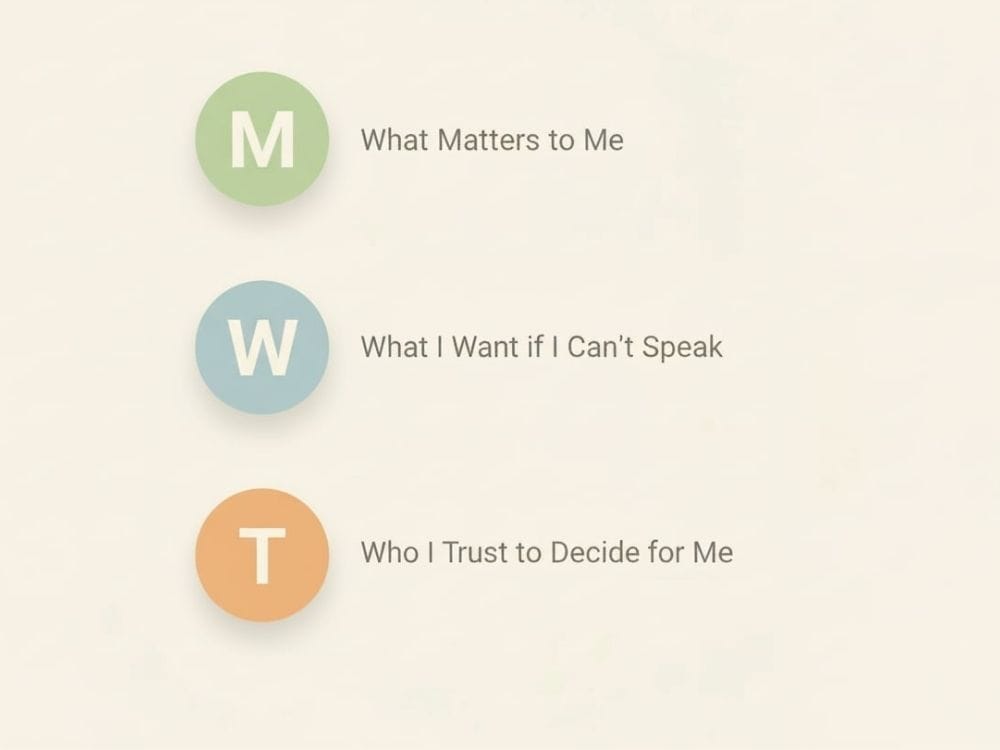
When you’re still unsure how to begin, a simple three-part approach keeps things focused and centered. It’s easy to remember, and it helps your loved ones understand not only your decisions but also the meaning behind them.
🔑 A Simple Way to Remember It: “My Wishes Told.”
M — What Matters to Me
W — What I Want if I Can’t Speak
T — Who I Trust to Decide for Me
This turns a difficult topic into a clear, manageable guide your whole family can follow.
Navigating Disagreement During End-of-Life Conversations
If someone in your family feels uncomfortable or disagrees during the conversation, try to refocus on what you all value most. Simple phrases like these can ease tension and keep the moment grounded in care:
- “I want to make things easier for you.”
- “I want our family to stay connected, not stressed.”
- “This is my way of taking care of you.”
Take a moment to ask yourself:
“If my family had to make decisions for me tomorrow, would they know what I’d want — and why?”
Key Takeaway
Talking openly about your medical wishes relieves your family from uncertainty. Even a short, honest conversation can help them feel supported and connected instead of overwhelmed.
Frequently Asked Questions

A Clear Path Forward
Understanding the difference between an advance directive and a living will gives you the clarity you need to make choices that reflect your values and protect the people you love. With just a few simple steps, you can create documents that guide your medical care and remove uncertainty during critical moments.
Whether you’re planning for yourself or supporting someone else, taking this step now offers peace of mind and confidence for the future.

Key Takeaway
Knowing the difference between an advance directive and a living will empowers you to make choices that reflect your values and protect your family from uncertainty.
Final Thoughts: A Meaningful Step Toward Peace of Mind
If you’ve made it this far, I want to offer something from my own experience.
I’ve sat with many families who wished they had talked about these decisions sooner, not because they expected anything to happen. They wanted to spare the people they love from that uncertainty. When your wishes are written down, it doesn’t remove the challenging moments, but it does remove the fear of choosing the “wrong” thing.
If you’re considering completing an advance directive or living will, you’re already taking a thoughtful and compassionate step. These conversations can feel heavy at first, but they often bring a quiet sense of relief. You don’t have to rush. You can move at a pace that feels right for you, one small step at a time.
And you’re not doing this alone. Even taking a few minutes to learn about these documents shows how deeply you care about the people in your life, your parents, your partner, your children, or anyone who may someday need to speak on your behalf. If this guide helped you feel a little more confident, a little less overwhelmed, or simply more prepared, I’m grateful to have played a small part in that clarity.
Planning is an act of love. Your future self and your family will thank you for it.
With Care and Compassion,
Matthew and the FPI Team
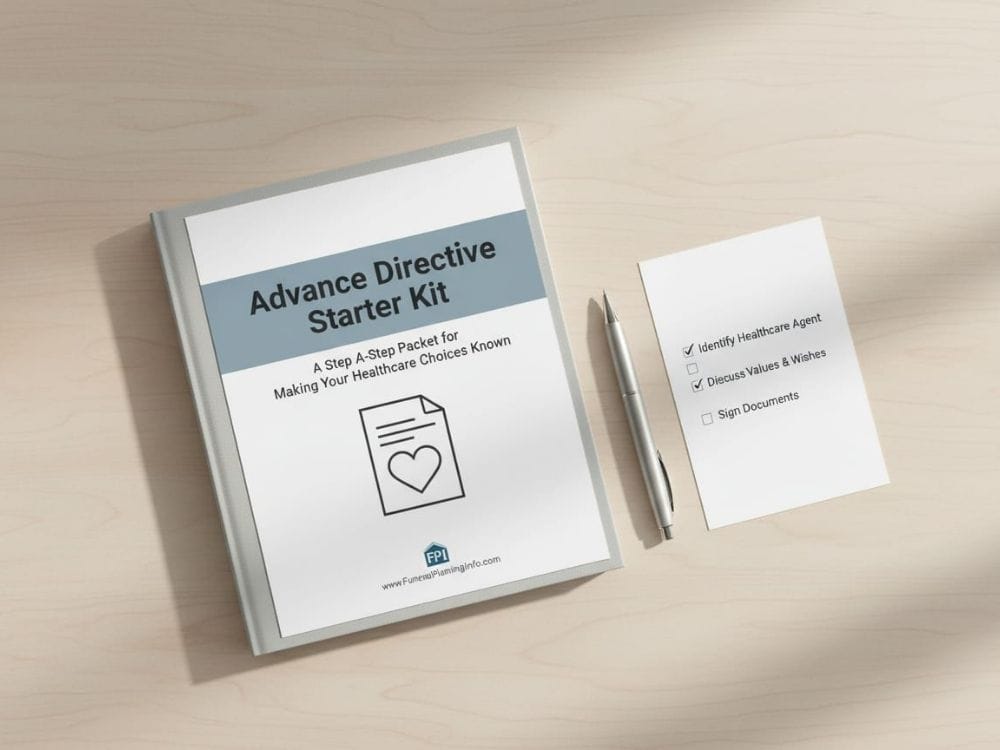
📥 Free Resource: Advance Directive Starter Kit
A little clarity now can bring peace later.
The Advance Directive Starter Kit walks you through each decision with simple worksheets and real-life guidance so you can document what matters most. Download your free kit and give your family the comfort of knowing your wishes.
Next Steps
Use a clear and attention-grabbing short paragraph to engage your audience and entice them to take action.
Related Posts